
Agent Security Box
Execution Control Layer

Multi‑agent systems don’t fail gracefully, they fail like a row of lit dynamite sticks, each one trusting the next not to explode.
If you architect them like a friendly team, you’re already compromised.
Architect them like a room full of strangers who might lie, cheat, or panic under pressure and suddenly everything gets safer.
Multi -Agent Zero Trust Architecture
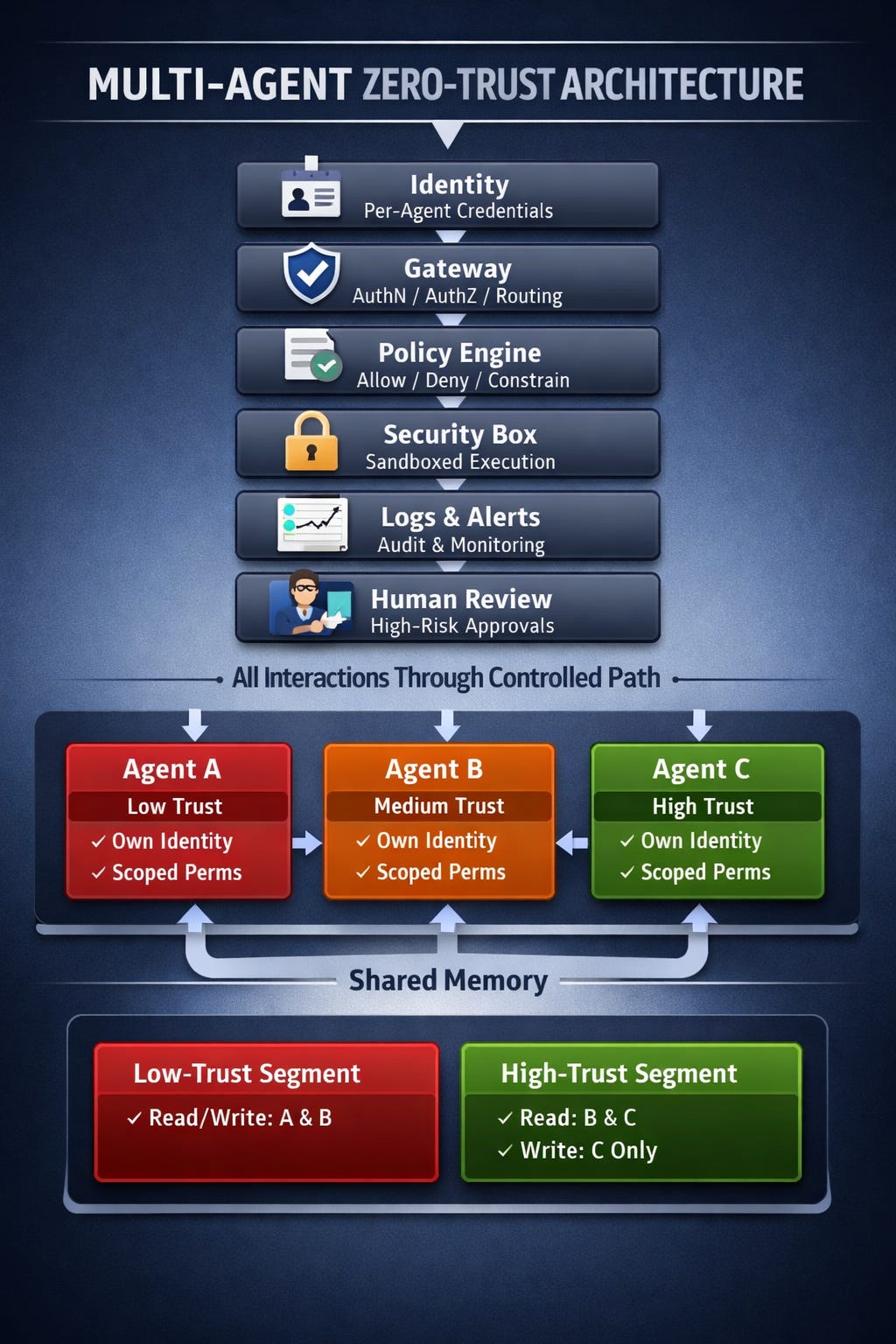
How to approach multi‑agent systems
Multi‑agent systems break in ways single agents never do, so the architecture has to assume coordination failures, privilege escalation, and emergent behavior from the start. The safest pattern is to treat every agent as an independent, untrusted principal with its own identity, permissions, and audit trail. No shared service accounts. No implicit trust. No “super‑agent” that can do everything.
Treat each agent as a separate untrusted principal
Each agent gets its own identity, its own scoped permissions, and its own blast radius. This prevents one agent’s compromise or misbehavior from cascading across the system.
Isolate shared memory and context
Shared memory is where multi‑agent systems quietly go off the rails. Segment memory by trust level and purpose. Low‑trust agents should never write into high‑trust knowledge bases. Treat memory writes like configuration changes, not casual notes.
Use an orchestration layer instead of agent‑to‑agent chaos
Direct agent‑to‑agent communication is where privilege escalation and prompt manipulation happen. A broker or coordinator routes tasks, enforces boundaries, and ensures each agent only sees the data and tools it is allowed to use.
All tool calls go through the same Security Box
No matter how many agents you have, execution must flow through one controlled path: identity → gateway → policy engine → logs/alerts → optional human approval. This keeps the system governable and auditable.
Multi‑agent risk patterns to explicitly guard against
Privilege escalation through delegation
A low‑privilege agent convinces a high‑privilege agent to perform an action on its behalf. Policies must evaluate the original requester, not just the last hop.
Poisoning shared memory
One agent writes misleading or harmful data into a shared knowledge base; another agent reads it and acts on it.
Memory segmentation and validation are essential.
Cross‑agent prompt manipulation
Agents influence each other’s reasoning through messages.
Treat prompts as configuration and gate modifications accordingly.
Identity → Gateway → Policy Engine → Logs/Alerts → Human‑in‑the‑Loop (for high‑risk actions)
This is the backbone of a safe multi‑agent architecture.
Identity defines who the agent is.
The gateway enforces what it can call.
The policy engine decides what’s allowed.
Logs and alerts provide observability.
Humans step in only for high‑impact actions.
Balancing cost and feasibility
The trick is not to build everything at once. Start with identity and scoped permissions. Add policy only where the risk justifies it. Layer in observability as usage grows. Introduce human approval only for actions that can cause real financial or operational damage.
Zero trust becomes affordable when you apply it where it matters, not everywhere.
Will Your Demo Make It To Production
The only multi‑agent systems that survive production are the ones engineered with zero implicit trust, strict identity boundaries, deterministic orchestration, and auditable state transitions.
Everything else eventually collapses under emergent behavior and cross‑agent interference.
Treat every agent like a potentially compromised subsystem, and your architecture will still be standing when the clever demos have long since crashed.
Thanks for stopping by and please share the post.
Thanks for reading! Subscribe for free to receive new posts and support my work.
Soul Hacked AI Labs-Curious Learners Who Build In Public
Brianna and Brian